Showing posts with label Travel. Show all posts

Tuesday, February 8, 2011

Snow day

Fresh snow is not exactly uncommon in the Sierras, but we always got full enjoyment, and so did the boys:


And of course the gremlins loved it...


Wednesday, January 26, 2011

The San Diego Wild Animal Park

Now known as the San Diego Zoo Safari Park, this is what a trip to the zoo should be like.  It's uncrowded, truly educational, well staffed and (most importantly) the animals are unstressed, comfortable and fun to watch.

Unlike traditional zoos, the animals are in large enclosures that replicate their natural habitats such as savanna, desert and woodlands.  The only exceptions are the primates and many of the birds, which are in more zoo-like enclosures.

A rather agile red-cheeked gibbon

A rather grumpy-looking lowland gorilla
The highlight of the visit is a half-hour tram tour around the perimeter of the huge open area that is landscaped to closely resemble several different areas in Africa.  Here, rhinoceroses, gazelles, zebras, water buffalo, giraffes and many more species live together in an environment just like home.

Unlikely neighbors - a white rhino and a herd of antelope

One of many gemsbok

Thompson's gazelles stand watch

Of course, the carnivores are kept separately.

A male lion presides over his pride
A large cheetah - the most magnificent animal in the park

All in all, the Wild Animal Park is a must-see during any visit to the San Diego area.  It's less than half the price of a trip to Sea World, and far more enjoyable.  The staff is friendly and informative - you'll learn quite a bit from the employees that loiter around the exhibits, eager to share their knowledge.

It is a bit of a drive though - about an hour from downtown San Diego.

Tuesday, January 25, 2011

Venice Beach

Los Angeles / Southnern California is a popular tourist destination.  But most visitors see little besides Disneyland and maybe Universal Studios.  It's too bad -- there are so many other worthy sights to see and things to do.

Venice Beach is one of them.  It's just a few miles north of LAX airport and is at the south end of Santa Monica, about a mile from the Santa Monica Pier (another worthy destination).

Venice Beach is famous for its Muscle Beach outdoor body-building gym, where Arnold Schwarzenegger trained in his early body-building days.  Onlookers once gathered to gawk at the heavily muscled (and doped-up) strongmen.

If that's what you expect to see, you'll be disappointed.  On our recent visit, the only participant was a flabby man in his sixties.

However, the anything-goes carnival / freakshow experience lives on.  There are regulars that you can expect to see on any given weekend:

The Venice Beach Gold Robot Man 
Harry Perry - Rollerblading Musical Genius

And some guys just come and go:

Bongo Drummer on Venice Beach Boardwalk
"Jingle Bells, Jingle Bells... Help me get drunk tonight"
Yet another street musician on the Venice Boardwalk

I love the guy with his own little soap opera:

An ambulance comes for one of his characters
A happy ending to his story

The street gymnasts are incredible.

Street gymnast jumps over one kid
But wait... here's ten, including two adults!
He literally flies over all ten of them!

There is plenty more to see and wonder at:

The variety of artwork is amazing

Don't be too shocked though, Venice can be dirty, smelly (incense and pot), lawless and kind of sad:

They don't show this part in the travel ads
Yes, it is legal (kind of)
Making his living as an "artist" ...
... He is very specific about his needs...

Venice is worth seeing -- it is not an experience easily forgotten.

Friday, January 14, 2011

Tribute to WWII Sub Vets

Each brick is a submarine - and its crew - eternally on patrol
My family has a history of military service:
  • Brother - Marine
  • Dad - Navy
  • Step-Dad - Army
  • Uncle - Navy
The USS Peto at Sea
But some of the most compelling stories came from my late Grandpa Charlie.  He (like so many others) lied about his age in order to enlist in the Navy during WWII.  He served, and saw action, on the USS Peto, a Gato-class submarine that was active from 1942 to 1946.

The Gato class was the core of America's submarine force in WWII, followed later in the war by the Balao and Tench classes.  Of the 77 Gato class boats, 20 were lost at sea.  A surviving relic, the Pampanito, can be boarded and toured at Fisherman's Wharf in San Francisco.  Here's Grandpa Charlie (second from left) when we toured it with him and some of his shipmates:

The USS Pampanito
Today's submariners live like kings compared to WWII submariners.  They have better life expectancies as well.  During WWII, the US lost 52 submarines with over 3,500 men - one in every seven submariners.  Only two submarines were lost with survivors - all of the others went down with all hands.  (Several survivors from lost submarines were discovered being held as POWs at the end of the war.)

Each marker is a lost boat - with a list of each crew member eternally on patrol
The Gato class was considered luxurious compared to other navies' boats at the time - it boasted laundry, refrigerated food and (gasp) distilled drinking water.  However, the men lived in conditions which would drive many people insane - crammed in like sardines, working shoulder-to-shoulder, rarely seeing sunlight or land, and worst of all, living with the constant fear of an unseen enemy lurking above.

The Peto's battle flag, which will one day grace my den
The experience produced the most tightly-knit group of men I've ever seen.  They share a bond not unlike cancer survivors or the early astronauts.  Their wives became close friends.  They went to each other's children's weddings.  It was sad to hear of the dwindling number of attendees at their annual conventions.

God bless you all, and we miss you G-Pa.

The author with Grandpa Charlie at Disneyland

Thursday, January 13, 2011

Getting around Tokyo by subway and rail


I've been to Japan several times - long enough between visits that I have had to re-learn the language, customs and survival skills each time.  For many people, it's a little scary.  I love the challenge.

The most recent time there was an added twist - I with accompanied by my wife, a wide-eyed Gaijin (Japanese for "White Devil" - or more crudely, "Barbarian") visiting for the first time.  But one of the reasons I love my wife is that she is unafraid, adventurous and outgoing.

How you'll be getting around is a big consideration when traveling anywhere, unless you're part of an organized group (which we avoid like the plague).  It's far more so when considering travel to Japan, especially one of the big cities like Osaka or Tokyo.  The language is not just different for us Westerners, it's alien.  There are no less than three written languages.  The sheer density of the place leads to a complex rats-nest of interlocking transit options.

The many transit lines form a virtual maze of tracks near Tokyo Station
Be not afraid, Westerner.  It's challenging and overwhelming at first, but easy to figure out when you adopt the right attitude.  And you'll marvel at the effectiveness and efficiency at moving such huge numbers of people around.  (And it's clean, safe and reliable!)

Trains run at most every five minutes, at least 5 AM to midnight
As you probably know, rail is the primary mode of transit within the country.  There are two things you really need to know:
  1. There are two types of rail:  Regional and local (which can be street level, elevated or subway).   Regional can either be high-speed (bullet trains) or what us Americans consider high-speed.
  2. There are multiple rail companies that operate interconnecting lines.  Even within Tokyo, there are multiple local rail and subway companies (one of which has always been more useful to me).  There is no one map that will tell you everything, especially if your plans include leaving Tokyo proper.  You should have at least the JR (Japan Rail) maps and Tokyo Subway map.  I have a link to major system maps at the end of this post.
A local JR line passes through a neighborhood in Tokyo
One other thing I'll let you know right away.  Unless you (improbably) are traveling somewhere without rail access, don't even think about renting a car.  If you do, you'll face streets ranging from this:


To this:

A typical intersection in Shibuya (Tokyo)
Maybe you've heard how crowded and claustrophobic Tokyo subways can be.  But don't panic!  Avoid morning and evening rush hours and you'll enjoy the journey -- almost always finding a seat.  This is about the most crowded you can expect during other hours:

On board the Shinjuku line
There are two major Tokyo subway companies, Tokyo Metro and Toei. Their combined 14 routes are largely within the central Tokyo area and overlap and intersect in lots of places.  Japan Rail (JR East) operates a large number of rail lines (largely above-ground) which can take you longer distances - well into many outlying areas.

What you do need to know:
  1. Many subway stations are not handicap-friendly.  During my most recent visit, I saw several that did not seem to have access at all to the platforms - sometimes several stories underground.
  2. Transfers between Toei and Metro are possible, but most riders must purchase a second ticket when boarding their connection.
  3. For the most part, Toei, JR and Tokyo Metro do not share stations, but they're often within walking distance of each other.
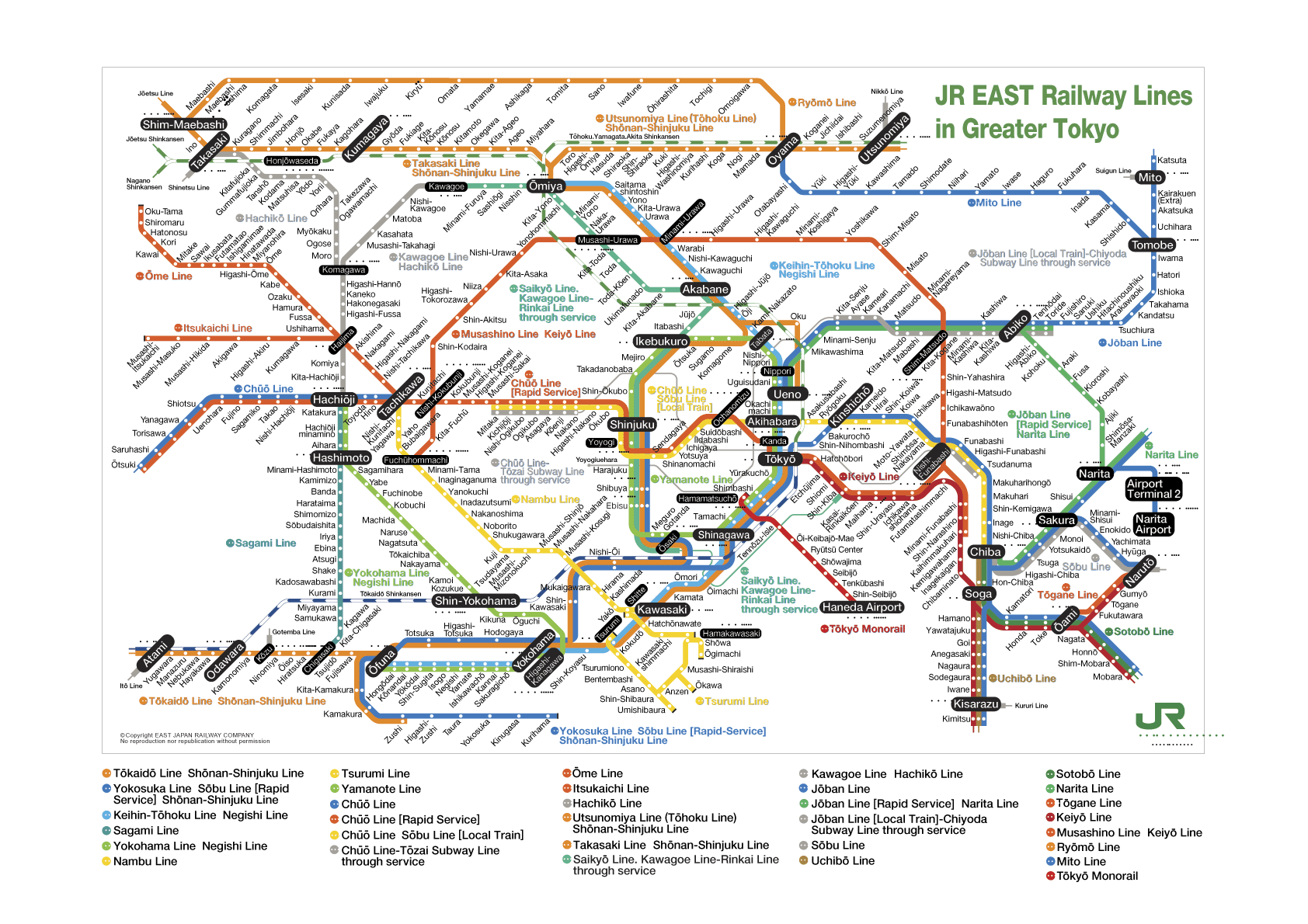
The systems are complex.  Here's a thumbnail of the overall Tokyo system (link  to full maps belowbelow):


But again, don't panic!  It's manageable once you choose your start and destination stations (remember that there are often several ways to get there, all at the same price).

Signs are in Japanese and English
The Tokyo subways (I have largely stuck to Tokyo Metro; there is a lot of redundancy in their stations, but Metro has more lines to choose from) are easy to navigate:
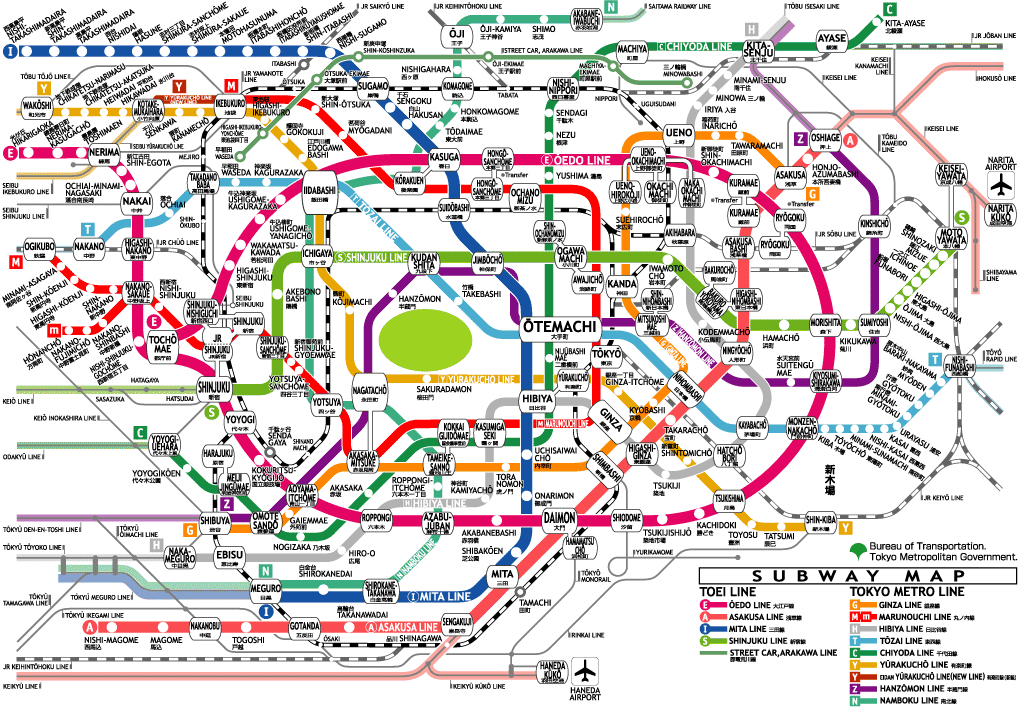
  1. Get a map and study it.  (Remember, the Metro map won't show Toei lines.)
  2. Identify your start and finish stations, and pick the best line(s) to get you there.  Don't worry about making a specific transfer time - the trains come very frequently.  Lines are color-coded and also have an identifying letter.
  3. Take a deep breath.  There will be a lot of hustle and bustle - you're best to take your time and enjoy the sensory overload.  Signs and announcements will be in both Japanese and English.
  4. Find your way to your starting station and locate the ticket machines.
  5. Look up!  There will be a graphical map that shows the cost to travel to your destination.  At this time you don't need to worry about transfers.
  6. The ticket machine will give you a chance to use English.  Put the required amount (or more) into the machine and identify your number of tickets.  The machine will dispense change and your ticket(s).
  7. Look at your map again.  You need to know the name of your line and the major stops on it.
  8. Now's the hard part!  Many stations have more than one line, and each line goes two directions.  Once you find a sign directing you to your line, make sure the stop(s) indicated on that sign are in the direction you want to go.  (Many times, your stop won't be listed, just one or two major stops.)
  9. There you go!  Navigate to the platform.  You will pass through a gate that will require (and return) your ticket.  Once at the platform, digital signs should indicate how long until the next train (usually only a few minutes).  Make sure one more time you are heading in the right direction!
  10. If you are transferring, you won't have to leave the "zone" inside the payment gates.  Hang on to your ticket.
  11. On arrival at your destination, your ticket is required to exit.  If you've underpaid, you will be prompted to return to a payment machine.
Inside Ikebukuro Station on a typical day
Be careful about asking for help buying your ticket!  Many Japanese feel obligated to try to help and won't admit it they have no clue or can't understand you.  Most of the employees aren't trained to handle Westerners.  Often if you stand near the ticket machine and look overtly confused for a few minutes, someone who speaks English will offer to help you.

One-day passes are offered as part of some travel packages - be aware that there are major exclusions.

As for JR, it's for longer distances, often to the "suburbs" of Tokyo such as Takasaki, and has been of little use to me in Tokyo proper.  I find the machines to be confusing compared to the subway lines.

I love the subway and train stations  too.  Tokyo Station (as you might guess, the central station, connecting subway, JR local rail and the Shinkansen bullet trains) is like a small city, complete with shopping malls, entertainment and more.  It partially sits under a huge conference center known as the "Glass Building"  Note that due to the size of the stations, many have exits separated by up to a mile.  If you plan to return via the same station, be sure to pay attention to which of the many exits you are leaving by.


Here are maps of the main lines:

JR East (Tokyo lines)
Tokyo Metro and Toei
Tokyo Metro and Toei (.pdf)
Easiest to read map of central Tokyo


Coming soon:  A post about the very, very sexy Shinkansen (Bullet Train):

The Shinkansen approaching Tokyo Station from Osaka

Monday, January 3, 2011

Huntington Beach - Surf City USA

Expect many posts about Huntington Beach and Newport Beach, because, well... we live there.

We love Southern California.  But I think we're the kind of people that no matter what region we lived in, we'd find something to like.

New Year's Day was one of the days that exemplifies why people choose to live in Orange County.  It was sunny, windless, crystal clear and a perfect temperature.

Rather than endure hours of Al Roker making inane comments about Tournament of Roses floats, we stepped outdoors.  A short drive got us to the Huntington Beach Pier.

Beach Volleyball on January 1st
Only a few hundred yards south of the busy pier area, the beach was nearly empty.  We enjoyed walking along the flat, smooth area exposed at low tide.  The seagulls certainly enjoyed all the food that low tide exposes.

Seagull at low tide in Huntington Beach
There was plenty of driftwood from the recent storms.

Looking north toward Huntington Beach Pier

We had wanted to go for a hike, but with the recent storms feared the trails would be muddy.  This was a terrific alternative!  At the turn point in Newport Beach there are beach cafes, restaurants and more.  On return, we were back at the Huntington Beach Pier for coffee at people watching.

Friday, December 31, 2010

Manzanar - WWII Japanese Concentration Camp

Lying just off the highway near the middle of the the Owens Valley near Mt. Whitney and the town of Lone Pine is an inconspicuous piece of history -- Manzanar.

This desolate and dusty place, which ranges from bitter cold to unbearable heat, was home to roughly a tenth of the 120,000 Japanese Americans imprisoned for the majority of the war's duration.  A full two-thirds of the prisoners were native-born American citizens.

Anti-Japanese sentiment ran hot
A visit to the small museum is a welcome break if driving between LA and Mammoth.  It's a moving and personal view of the tragedy inflicted on innocents during wartime.

A page from the roster of prisoners
The displays include reconstructions of daily life inside the prison camp, personal accounts and many stirring accounts of personal tragedy, persistence and triumph.

It's also free.

Row after row of barracks